Design
UX vs UI: You've Been Asking the Wrong Question
The UX vs UI debate is everywhere, and it is mostly a distraction. What founders actually need to understand is why these two disciplines cannot be separated, and what happens when you try.
Pampi Raghuwanshi · 2026-06-10 · 5 min read
UX UI Product Design Founders Strategy
The UX vs UI debate shows up everywhere. In job postings, in design forums, in conversations between founders trying to make their first design hire. People argue about which matters more, which comes first, which is worth the budget. The conversation is almost always circular - and it almost always misses the point.
Why the Debate Will Not Die
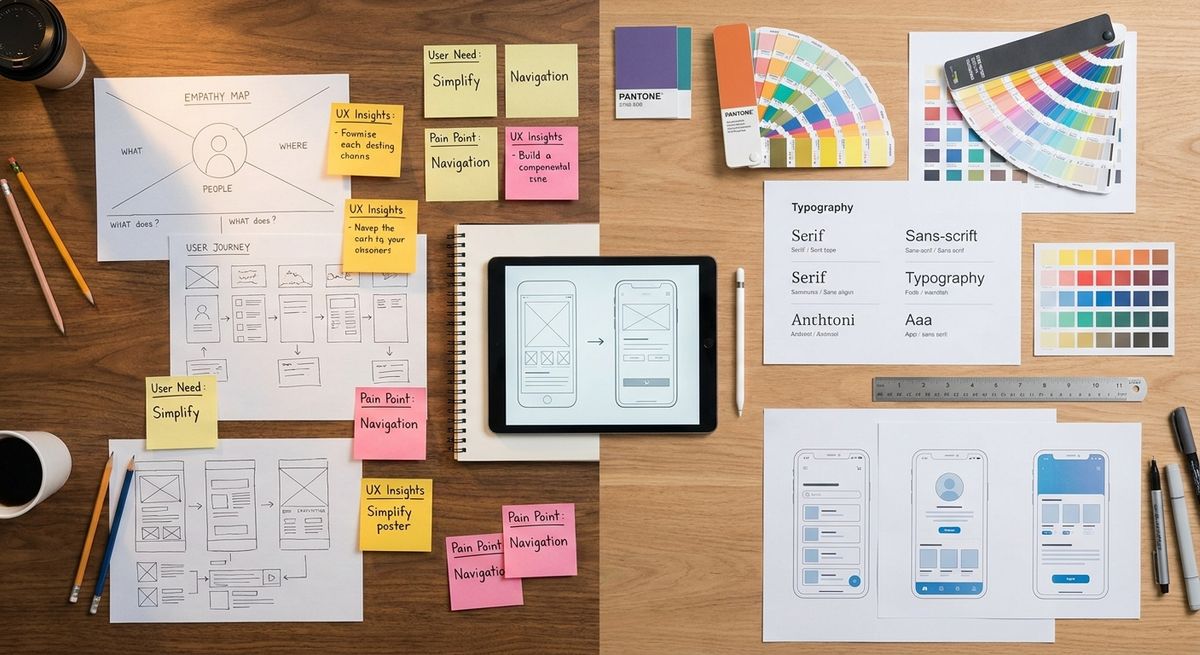
The confusion comes from how the industry labels these roles. UX gets associated with research, wireframes, empathy maps, and strategy. UI gets associated with visual design, typography, color, and polish. The implication is that they are sequential - you do UX first, then hand it off to UI.
But any designer who has actually shipped products knows this is a fiction. The two are in constant conversation with each other. A UI decision changes the user experience. A UX decision shapes what is even possible to design. Treating them as separate phases is how you end up with beautiful products that nobody knows how to use.
What UX Actually Is
User experience is the total impression someone has of your product - from the moment they first hear about it to the moment they stop using it. It includes how they find you, how they onboard, how they understand what they are supposed to do, whether they succeed at their goal, and whether they come back.
Good UX means your product fits into someone's life without friction. It means they can do what they came to do - quickly, without confusion, without feeling like they need a tutorial. Most UX work is simply about reducing the distance between what a user wants and what they can actually do in your product.
What UI Actually Is
The user interface is the layer where a person physically touches your product - every screen, every button, every label, every error message, every empty state. It is where your product strategy becomes concrete, and where trust is either built or lost in the first thirty seconds.
A bad UI can ruin a well-designed experience. A beautiful UI cannot save a broken one. But a thoughtful UI - where every visual choice serves a function - reduces cognitive load, guides users toward the right action, and makes a product feel like it was built specifically for them.
UX is the destination. UI is the road. You cannot build one without thinking deeply about the other.
Where Founders Go Wrong
Most founder mistakes in this space fall into one of two buckets. The first is investing heavily in UI before UX is solid - you end up with a polished product that confuses every new user. The second is treating UX as a research phase that ends, as if you can understand your users once and then stop paying attention to them.
The founders who build products people genuinely love treat UX as a continuous practice. They are always learning something from their users. And they let those learnings reshape the UI regularly - not just at launch, but through every iteration.
The Question That Actually Matters
Instead of asking which discipline matters more, ask this: do your users know what to do next, and does the screen make it easy to do it? If the answer to both is yes, you are doing both well. If the answer to either is no, you have work to do - and it touches UX and UI at the same time.
The teams that consistently ship great products do not separate these disciplines cleanly. They hold them together. Every wireframe is also a visual sketch. Every UI component carries a UX assumption baked in. The best product designers I have worked with think in both dimensions simultaneously - and that is exactly what you should look for when building the team that builds your product.